You read several textbook pages, highlight nearly every line, and still struggle to explain what you learned. That’s because useful notes aren’t a copy of the book; they’re a shorter version in your own words, designed to help you review and recall the key ideas.
Learning how to take notes from a textbook starts with a clear process: prepare the chapter, read in small sections, capture the main ideas, choose a note format that fits the material, and review your notes afterward. Start by preparing the chapter so each page has a purpose.
Prepare the Textbook Before You Start Taking Notes
Good notes begin before you read the first paragraph. Take a few minutes to understand the chapter’s structure, identify its purpose, and prepare a place for ideas to land. This short preview keeps you from treating every sentence as equally important.
Preview the Chapter Structure
Start with the table of contents, chapter title, section headings, subheadings, and end-of-chapter summary. Scan bold terms, diagrams, charts, captions, review questions, and learning objectives. These features act like a map, showing you where the author is going before you follow the full route.
Next, write down the chapter’s main subject in one sentence. If the title is “The Causes of the Civil War,” your sentence might be, “This chapter explains the political, economic, and social conflicts that led to the Civil War.” You can refine it after reading, but creating a starting point gives your attention a clear target.
Pay attention to the chapter’s organization, too. Words such as “first,” “however,” “as a result,” and “in contrast” often reveal how ideas connect. A textbook’s headings may also predict the questions your notes should answer.
1. Set Up Your Notes Before Reading

Choose your note-taking format before you begin. A notebook, tablet, or document can work well, provided you use the same structure throughout the chapter. Leave space for the chapter title, page numbers, key terms, questions, and a short summary.
For dense subjects, a simple Cornell-style layout can help. Divide the page into a wide notes area and a narrow column for questions or keywords. Leave several lines at the bottom for a summary. This structure separates information from the prompts you will use during review.
You should also gather only the tools you need:
- Your textbook and course materials
- One notebook or digital document
- A pencil or dark writing tool
- One or two highlighters
- Sticky notes for questions or pages to revisit
Too many colors can turn your notes into a decoration project. Give each color a clear job, such as definitions, examples, or questions.
2. Set a Purpose for the Reading
Before you start taking notes from a textbook, check your assignment, lecture slides, or study guide. Look for terms, concepts, and learning objectives your instructor emphasized. Those details help you decide what deserves space in your notes.
Then turn the section headings into questions. For example, change “Photosynthesis” into “How does photosynthesis convert light energy?” Read to answer that question, rather than copying every detail beneath the heading.
Marking a passage before you understand its purpose often produces a page full of color but very little useful information.
Avoid highlighting during your first quick preview. Read a short passage, pause, and identify its main point in your own words. The UNC Learning Center’s annotation guidance also recommends writing brief questions, comments, and summaries instead of marking everything. This approach gives each note a reason to exist.
How to Take Notes from a Textbook, Step by Step
Once you have previewed the chapter, read one section at a time and decide what deserves a place in your notes. The goal is to build a clear study guide, not a smaller copy of the textbook. Pause often, explain ideas from memory, and record only information that helps you understand or recall the material.
1. Find the Main Idea Before You Record the Details

Before writing anything, ask, “What is the author trying to explain, prove, or describe?” The answer is usually more useful than any single sentence on the page.
Start with the heading and the first sentence of each paragraph. These often introduce the subject or make the author’s main claim. However, don’t assume the first sentence always contains the central idea. The author may give background first and reveal the key point later.
After reading the paragraph or short section, pause and state its message in one sentence. Then separate that message from the supporting material. Examples, statistics, repeated explanations, historical details, and interesting side facts may clarify the idea, but they don’t all belong in your main notes.
A useful test is to remove a detail mentally. If the paragraph still makes sense without it, the detail is probably supporting information. Keep it only when your instructor emphasizes it, the example makes a difficult concept easier, or it helps explain a cause-and-effect relationship.
The McGraw Center’s active textbook reading guidance recommends pausing during reading instead of moving through every page without checking your understanding. Your notes should answer, “What is this section really saying?”
2. Write in Your Own Words Without Losing Accuracy
Copying feels efficient, but it often creates long notes and hides confusion. Your hand may reproduce the textbook perfectly while your mind never processes the idea.
Read a short passage, look away from the page, and explain it as if you were telling a classmate. Use plain language first. Then check the textbook to correct missing details, dates, names, or technical terms.
For example, instead of copying a paragraph about supply and demand, you might write, “When demand rises and supply stays limited, prices usually increase.” That sentence captures the relationship without carrying unnecessary wording into your review.
Keep exact wording when changing it could alter the meaning. This includes formulas, technical definitions, quotations, laws, equations, and key vocabulary. Put quotation marks around copied language and add the page number so you can find it later.
For more ways to organize and review what you write, see these effective study note methods.
3. Use Questions to Make Notes More Active
Turn each major heading into a question before you read. “Causes of erosion” can become, “What causes erosion, and how does it change the land?” The question gives your reading a target and creates a prompt for later self-testing.
Useful questions include:
- Why did this event happen?
- What are the steps in this process?
- How are these two ideas different?
- What caused this result?
- How does the example support the main concept?
- How does this chapter connect to an earlier lesson?
Write the question in your notes, then place the answer beneath it in your own words. During review, cover the answer and try to recall it without looking. If you cannot answer, return to that section rather than rereading the entire chapter.
Questions also reveal gaps. When a heading seems clear but you cannot explain the answer, your notes need more work. Add one precise sentence, a relevant example, or a page reference before moving on.
Choose a Note-Taking Method That Fits the Subject
The best way to take notes from a textbook depends on the material in front of you. A structured method helps you capture the main ideas without forcing every chapter into the same format. Choose a layout that matches the way the subject is organized, then adjust it when the material changes.
4. Use the Cornell Method for Organized Review
The Cornell method divides each page into three parts: a wide notes area on the right, a narrower question or keyword column on the left, and a summary space across the bottom. The main notes area should take about two-thirds of the page, while the cue column takes about one-third. Reserve several lines at the bottom for your summary.
While reading, record explanations, examples, definitions, and relationships in the wide section. Don’t stop to create perfect questions yet. After you finish the page, review what you wrote and add keywords or questions in the narrow column. These cues turn your notes into quick self-test prompts.
Finish by writing a summary of no more than three sentences. State the page’s central idea and the most important supporting point. The Cornell note-taking system works well because one page supports both writing and later recall.
5. Use Outline Notes for Chapters With Clear Structure
Outline notes follow the textbook’s existing hierarchy. Write the broad topic near the left margin, place related subtopics beneath it, and indent supporting facts farther to the right. Each level shows how the ideas connect.
For example:
- The main heading identifies the chapter’s broad subject.
- A subheading names one major part of that subject.
- A detail provides evidence, an example, or an important explanation.
- A subheading names one major part of that subject.
This format works especially well when the author presents information in a clear order. History chapters may move through causes, events, and consequences. Psychology texts often organize theories by researchers, principles, and applications. Law textbooks commonly separate rules, exceptions, and case examples.
Follow the textbook headings instead of inventing a new structure for every page. Indentation then becomes a visual map. When you review, you can quickly see which facts support each main idea. If you want additional guidance on effective note-taking methods, compare your outline with the chapter’s headings and learning objectives.
6. Use Tables, Charts, or Mind Maps for Connected Ideas
Long lists can hide relationships between ideas. A visual format works better when you need to compare, sequence, or connect information.
Use a comparison table for theories, historical figures, competing systems, or similar terms. Include only useful categories, such as purpose, key features, strengths, and limitations. Flowcharts fit processes with a clear sequence, such as digestion, a court procedure, or a laboratory method.
Mind maps work well when one central concept has several related branches. Place the main idea in the center, then add branches for terms, causes, examples, and connected topics. Keep each visual simple enough to review in under a minute. Too many colors, arrows, or tiny details can make the page harder to study.
7. Adapt Notes for Formulas, Diagrams, and Difficult Terms
Different subjects require different details. For math and physics, write the formula, define every symbol, and include one worked example. A formula without its meaning is difficult to recall later.
For science, label diagrams and describe processes in order. In history, connect dates to causes, events, and results instead of keeping a disconnected list. When you meet unfamiliar vocabulary, write a plain-language definition and one short example. This gives the term a place in your memory and makes review more useful.
Turn Textbook Notes Into a Study Tool You Will Actually Use
Notes become useful when they help you retrieve information without opening the textbook. After each section, chapter, or study session, reshape your notes into summaries, questions, connections, and review prompts. That extra step turns passive pages into a study tool you can use before a quiz or exam.
8. Summarize Each Section in a Few Clear Sentences
After finishing a section, close the textbook and write a short summary. Use your own words, and keep it to a few clear sentences. A strong summary answers three questions:
- What was this section about?
- Why does the information matter?
- How do the main ideas connect?
For example, a biology summary might say, “Cellular respiration breaks down glucose to release usable energy for the cell. It depends on several linked steps, and each step produces materials used by the next one.” That summary gives you the central idea without copying the paragraph.
Avoid adding details that never appeared in your notes. A summary should clarify what you studied, not become a second set of notes filled with unrelated facts. If you cannot explain the section in your own words, return to the confusing point and add one brief explanation.
You can find more ideas for studying notes effectively when you finish building your summary.
9. Review by Covering the Answers and Testing Yourself
If you used a Cornell-style layout, cover the notes column with a sheet of paper. Read each question or keyword in the cue column, answer from memory, and then uncover the response to check your accuracy.
Use other forms of active recall when the layout calls for them. Turn key terms into flashcards, explain a concept aloud, draw a process from memory, or solve a similar problem without viewing the example. Retrieval practice works because you must produce the answer, rather than simply recognize familiar words while rereading. Research on retrieval practice also supports using recall to strengthen learning.
10. Link New Ideas to Earlier Chapters
New information becomes easier to remember when you attach it to something you already understand. Add arrows, brief contrasts, or a “connects to” note whenever a new term depends on an earlier idea.
For example, connect cellular respiration to photosynthesis. Photosynthesis stores energy in glucose, while cellular respiration releases that stored energy for cell use. In history notes, link a later event to an earlier political change, then write the cause-and-effect relationship in one sentence.
These connections reveal the chapter’s structure. They also help you answer questions that require explanation instead of simple memorization.
11. Review Notes on a Simple Schedule
Review your notes briefly the same day or the next day. Later in the week, test yourself again, then complete another self-test before the exam. Spreading reviews across several days gives you more chances to find weak areas.
Each review should focus on recall and correction, not rereading every line. Add missing information in a different color so you can see what you forgot. Mark topics that still need help, then ask your instructor, revisit the textbook, or practice them again.
Avoid Common Textbook Note-Taking Mistakes
Knowing how to take notes from a textbook also means knowing what to leave out. Many weak notes come from passive habits: copying full paragraphs, coloring every page, ignoring confusing ideas, or waiting until exam week to organize everything. Avoid these mistakes, and your notes will become shorter, clearer, and easier to review.
12. Do Not Copy or Highlight Nearly Every Sentence
Copied notes often become a second textbook. They take a long time to write, yet they don’t force you to process the material. Highlighting every sentence causes the same problem because it removes the difference between important information and background detail.
Read a short passage first, then close the book or look away. Write a brief summary in your own words before adding supporting details. For example, write, “The cell membrane controls what enters and leaves the cell,” then add only the details that explain how it does that.
Limit highlighting to key terms, definitions, and lines that answer a clear question. If a whole page is bright yellow, none of the markings can guide your attention during review. The UNC Learning Center’s textbook reading guidance also recommends active reading strategies that make you think while you read.
13. Do Not Make Notes Too Pretty to Be Useful
Color, boxes, arrows, and diagrams can improve memory and show how ideas fit together. However, decoration should support understanding, not replace it. If you spend more time choosing colors or drawing borders than explaining the material, your system has become a distraction.
Use a small, consistent color system. For example, mark terms in blue and questions in orange. Add a box around a rule or formula only when the shape helps you find it later. Keep handwriting, spacing, and headings easy to scan.
A useful page should let you find the main idea within a few seconds. Leave enough white space between topics, and avoid filling every corner with arrows or tiny comments.
14. Do Not Leave Confusing Ideas Unmarked
When a sentence makes no sense, don’t move past it and hope the meaning becomes clear later. Place a question mark beside the idea, or write a precise question such as, “Why does increasing temperature speed up this reaction?”
A visible question gives you a clear next step. Check another class source, ask your teacher, discuss the point with a classmate, or return to the textbook with the question in mind. Pretending that confusing material makes sense only hides the gap until test day.
15. Do Not Wait Until the Night Before the Test
Last-minute note copying creates stress and leaves no time for practice. Instead, spend a short session updating your notes while the chapter is still fresh. Then review them regularly by answering questions, explaining concepts, or solving problems without looking at the page.
Before calling your notes finished, check that they include:
- The main idea
- Key terms and definitions
- Important supporting details
- Page references
- Unanswered questions
- A brief summary
- A plan for review
Short, regular updates keep your notes useful. They also give you time to find help before a confusing topic becomes an exam emergency.
Conclusion
Learning how to take notes from a textbook becomes easier when you stop treating every sentence as equally important. Preview the chapter, read a small section, identify its main idea, and write what you remember in your own words. Then add only the key details, page numbers, and a brief summary that will help you review later.
Strong notes are selective, brief, and built for self-testing. Try one method, such as effective study note methods, with your next chapter instead of waiting for a perfect system. After reading, close the book, answer your questions from memory, and check your notes for gaps.
The best notes don’t come from writing down more words. They come from thinking carefully about what the textbook means and creating a clear path back to that knowledge.
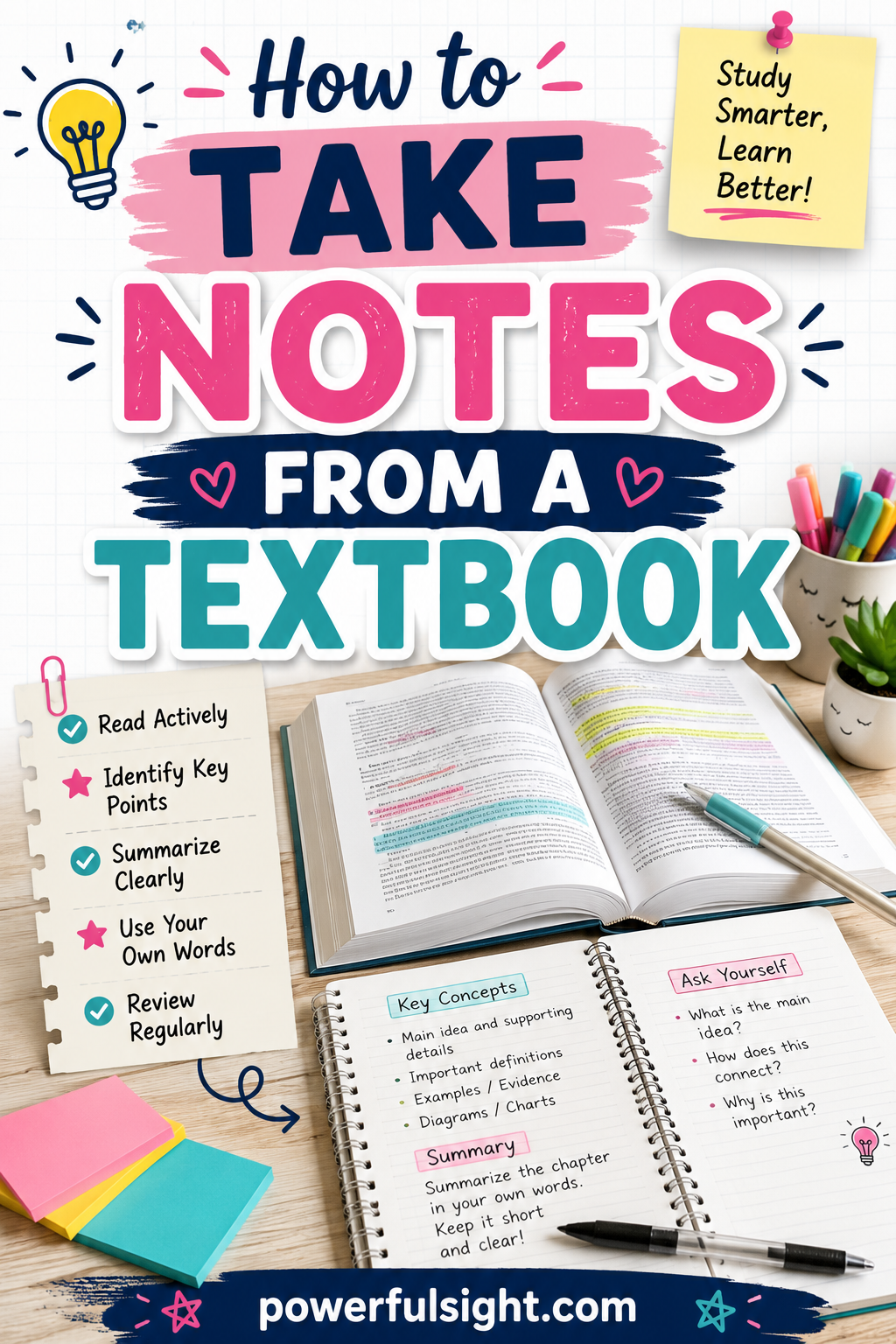
Save the pin for later

- 60 Color Tattoos That Healed Beautifully - 25/09/2026
- 40 Most Painful Tattoo Spots - 24/09/2026
- 20 Tattoo Aftercare Mistakes That Ruin Fresh Ink - 23/09/2026

