One classroom, one page, and a room full of different interpretations. While one student spots the main idea, another focuses on a small detail, and someone else is still wondering what a key sentence means. Well-timed reading questions help bring those responses together without turning the lesson into a test.
Before reading, prompts prepare students and activate what they already know. During reading, questions help them stay focused, notice confusion, make predictions, and think beyond the obvious. Afterward, they support discussion, summarizing, and remembering what they read, much like the active reading strategies for better retention that turn reading into an active conversation with the text.
The 50 questions below work with fiction, nonfiction, picture books, novels, articles, and read-alouds. Use them as written or adjust the wording to match your students, then begin with the before-reading prompts.
Key Takeaways
- Use before-reading questions to activate prior knowledge, set a purpose, and invite predictions about the text.
- During reading, ask questions that help students monitor understanding, clarify confusing details, and check their predictions.
- After reading, focus on the main idea, evidence, themes, personal responses, and lingering questions.
- Encourage students to create their own questions, since self-questioning keeps reading active and focused.
- For stronger retention, combine discussion with active reading strategies for better retention and questions that promote comprehension.
Why before, during, and after reading questions help students learn
Reading questions give students a purpose instead of asking them to move through a page on autopilot. The three-stage approach creates a simple rhythm: prepare before reading, check understanding during reading, and make meaning after reading.
Research from the National Reading Panel identifies question asking and comprehension monitoring as evidence-supported reading strategies. Students learn more when teachers model these habits, practice them with the class, and gradually give students responsibility.

Before reading builds a mental starting point
Before-reading questions activate background knowledge and help students connect the text to something familiar. They also give students a reason to read, such as finding out why an event happened or deciding what problem a character must solve.
Predictions make the upcoming reading feel purposeful. Students might study a title, image, heading, or short description and explain what they expect to learn. Their predictions don’t need to be correct. The goal is to create an idea they can confirm, revise, or reject as they read.
This stage also helps teachers notice gaps in background knowledge. If students don’t recognize an important term or concept, a brief explanation before reading can prevent confusion later. For older students, turning headings into questions can also improve note-taking and recall. These textbook note-taking strategies build naturally from the same habit.
During reading keeps comprehension active
During-reading questions help students pause and check whether the text still makes sense. Instead of waiting until the final page to discover confusion, students learn to stop, reread, look for clues, and ask what a difficult sentence means.
These questions also direct attention toward details that support understanding. Students may notice a character’s motivation, connect a cause to an effect, infer an unfamiliar word, or revise an earlier prediction when new evidence appears.
A useful question does more than test memory. It gives students a reading action, such as rereading, searching for evidence, or explaining an idea.
Teachers can model this process with a short think-aloud: “This part doesn’t match my prediction, so I’m going back to the earlier paragraph.” Pauses, partner talk, and sticky notes give students room to explain their thinking without interrupting the entire lesson.
After reading turns understanding into learning
After-reading questions help students retell events, summarize central ideas, discuss evidence, evaluate the author’s choices, and connect the text to their own experiences. They also reveal whether students understood the whole text or only remembered isolated details.
Reflection matters because comprehension doesn’t end when students reach the last sentence. Asking what changed, what remains unclear, or which detail mattered most encourages students to organize and extend what they learned.
Teachers don’t need to ask every question in one lesson. Choose a few prompts that fit the text, lesson goal, age group, and reading level. A three-part question chart can make the routine visible, with columns for before reading, during reading, and after reading. Over time, students can add their own questions and take greater control of the conversation.
50 Questions to Ask Before, During, and After Reading in Class
Use these prompts to help students approach reading with curiosity, attention, and purpose. Choose a few for each lesson rather than asking all 50 at once.
Before reading: build curiosity and connect to what students know
Before opening the first page, invite students to study the title, cover, headings, illustrations, and other visible clues. Predictions should come from evidence students can point to, not random guesses.

- What does the title make you think this text may be about? This activates first impressions.
- What do you notice on the cover? This builds careful observation.
- What might the illustrations reveal about the topic or story? This connects images with meaning.
- What do the headings suggest you will learn? This previews the text structure.
- Which text features do you notice, such as captions, maps, or bold words? This prepares students for nonfiction.
- Where might this story take place? This introduces the setting in fiction.
- Who might the characters be, and what could they want? This encourages early character thinking.
- What topic does the text seem to introduce? This helps students identify the subject.
- What do you already know about this topic? This activates background knowledge.
- Have you read, seen, or experienced something similar? This creates a personal connection.
- What do you want to learn before you finish reading? This gives students a purpose.
- What do you predict will happen or be explained? This encourages anticipation.
- Which visible clue supports your prediction? This connects predictions with evidence.
- What questions do you already have? This gives students a reason to keep reading.
- Whose point of view or possible bias might shape this text? This introduces perspective and source awareness.
The IES prediction prompts for readers encourage students to find clues, make predictions, check them, and explain what they learned.
During reading: check understanding and think beyond the page
Pause at natural points so students can explain their thinking. They can reread, use context clues, and revise earlier ideas when new evidence appears.
16. What Is Happening Right Now?
This checks basic understanding and helps the reader explain what is currently taking place in the story or passage.
17. What Is the Main Idea So Far?
This keeps attention on the text’s main focus and encourages the reader to identify what the passage is mostly about.
18. Which Detail Seems Most Important?
This helps students learn how to separate key information from minor facts and focus on the details that matter most.
19. What Does the Character Want at This Point?
This question works especially well with fiction. It encourages students to think about a character’s goals, motivations, and decisions.
20. How Might the Character Be Feeling?
This develops emotional inference by asking students to look beyond what a character says and consider how their actions and circumstances might reveal their feelings.
21. What Caused This Event or Idea?
This examines cause and effect and helps students understand why something happened in the text.
22. What Happened Because of It?
This traces the results of an event, decision, or idea and encourages students to connect different parts of the text.
23. What Might This Unfamiliar Word Mean From Context?
Rather than immediately reaching for a dictionary, encourage students to use the surrounding text to work out the meaning of unfamiliar words. This builds vocabulary and independent reading skills.
24. Which Nearby Words or Sentences Provide Clues?
This teaches students how to identify context clues. Encourage them to look at the words and sentences around an unfamiliar term for information that can help them understand it.
25. Which Part Feels Confusing?
This encourages honest comprehension monitoring. Students learn that it is normal not to understand everything immediately and that recognizing confusion is the first step toward fixing it.
26. Should We Reread That Sentence or Paragraph?
This turns confusion into a practical reading action. Rereading can help students notice details they missed the first time and clarify difficult sections.
27. What Evidence Supports Your Answer?
This teaches students to return to the text instead of relying only on memory or guesses. Ask them to point to a sentence, detail, or event that supports their answer.
28. What Can You Infer Even Though the Author Doesn’t Say It Directly?
This develops deeper comprehension and encourages students to read between the lines. They must combine clues from the text with what they already know to form an inference.
29. What Clue From the Author Helped You Make That Inference?
This connects reasoning with textual evidence. Students learn that a good inference should be based on clues in the text rather than a random assumption.
30. Has Your Prediction Changed? Explain Why.
This shows students that strong readers revise their thinking as they gain new information. Encourage them to explain what they learned that caused their prediction to change.
After reading: remember, discuss, evaluate, and make connections
After the final page, move beyond plot recall. Ask students to summarize, evaluate ideas, connect the text to life, and identify what they still want to understand.
Students can record selected answers in a reading journal for comprehension, then review their responses during discussion or later study.
How to use reading questions without turning class into a quiz
Reading questions work best when they guide thinking rather than measure every answer. Choose a few prompts that match your lesson goal, then give students time to discuss, write, and return to the text for evidence.
Choose a small set for each lesson
You don’t need all 50 questions in one class. Select three to five prompts that fit the text and place them on the board before reading. Include at least one question that prepares students, one that checks understanding, and one that invites reflection.
Assign different questions to small groups when several prompts fit the lesson. Each group can become responsible for one question, then share its answer with the class. This approach creates several paths through the text instead of sending every student through the same series of teacher checks.

A before-during-after chart also keeps the routine visible. Students can record predictions in the first column, new thinking or confusion in the second, and conclusions in the third. A reading journal can extend this habit for students who need more space to explain their ideas, similar to these reading journals for children.
Model the thinking behind one question
Before asking students to respond, model one prompt with a short think-aloud. For example, say, “The character keeps looking at the locked door, so I think the door may matter later. I found that clue in the second paragraph.”
This shows students that readers make claims, notice clues, and revise ideas. Reading Rockets describes think-alouds as a way to model predictions, connections, questions, and comprehension monitoring. You can also find practical guidance on using think-alouds to improve comprehension.
After asking a question, allow quiet wait time. Give students at least three seconds to think before accepting answers, and let partners talk before whole-class sharing. Follow up with prompts such as:
- “What makes you think that?”
- “Where did you find that clue?”
- “Did anyone interpret that detail differently?”
- “What could we reread to check?”
Different answers are welcome when students can support them with evidence. The goal is not to produce one approved sentence. Students should learn to explain how the text shaped their thinking.
Use several ways for students to respond
Oral answers work well during a read-aloud, but they shouldn’t be the only option. Partner talk gives students a low-pressure rehearsal before they speak to the class. Sticky notes let them mark a confusing sentence, an important detail, or a prediction without stopping the reading for a long discussion.
Short written responses and exit slips provide a quick record of understanding. Ask students to answer one question, name one supporting detail, or write one question they still have. These responses help you decide whether to reread, clarify vocabulary, or move forward.
Try these simple routines
For a 30-minute read-aloud, use this structure:
- Spend five minutes previewing the title, images, and one before-reading question.
- Read for 10 minutes, pausing twice for partner talk and one during-reading prompt.
- Read for another 10 minutes while students add notes to their charts.
- Use the final five minutes for one after-reading question and an exit slip.
During independent reading, give each student three selected prompts. Students answer one before reading, pause for a sticky-note response during reading, and complete one short reflection afterward. You can collect the charts, hold brief conferences, or invite students to share one evidence-based insight with a partner. This keeps questions connected to reading rather than turning every page into a quiz.
Adapt the questions for different readers and text types
The same reading prompt won’t work equally well for every student or every text. Keep the goal steady, then adjust the wording, support, and level of thinking. A younger reader may need a question about one clear detail, while an older student can examine evidence, bias, or the author’s choices.

Match the prompt to the reader
For younger students, use short questions with familiar words. Ask about what they can see, who is present, what happened, and what may happen next. Pictures, gestures, pointing, and quick partner talk can help children respond before they have the vocabulary to explain a full idea.
English language learners may understand the text before they can answer in complete English. Offer sentence starters such as “I notice…”, “I think ___ because…”, or “The character feels ___.” A small word bank with names, actions, feelings, and key terms can reduce language pressure. Partner support also gives students a chance to rehearse their thoughts.
Struggling readers often need fewer questions, more time, and repeated access to the text. Read a short passage again, point students toward the relevant paragraph, and ask them to underline or point to evidence. The reading comprehension strategies for English learners from Colorín Colorado also support background knowledge, vocabulary, and guided discussion.
Older readers should move beyond recall. Ask them to explain how an idea develops, compare evidence, infer an unstated meaning, or evaluate the author’s reasoning. Advanced readers can also question reliability, point of view, structure, and what the author left out. Students in high school may benefit from active reading strategies for high school students, including annotation and evidence-based notes.
Adjust questions for each text type
Fiction questions should guide students toward characters, setting, conflict, events, and theme. Ask what a character wants, how the setting affects the action, which event creates a change, or what the story suggests about a larger idea.
For nonfiction, focus on headings, claims, evidence, key details, vocabulary, author’s purpose, and text features. Students might explain how a heading previews a section, identify evidence for a claim, or describe why the author included a chart, caption, or photograph.
The format also changes the best stopping points:
- During a read-aloud, pause for predictions, feelings, and quick partner responses.
- With a textbook, ask students to turn headings and bold terms into questions.
- For a short article, focus on the central idea, supporting evidence, and author’s purpose.
- With a poem, discuss imagery, repetition, sound, speaker, and mood.
- In a digital text, include hyperlinks, images, menus, captions, and the order in which information appears.
Keep the questions themselves simple, even when the thinking is demanding. Clear language gives students more room to think about the text instead of decoding the teacher’s prompt.
Simple ways to tell whether students are thinking deeply
Deep thinking appears in the way students explain, question, and revise their ideas. A correct answer alone doesn’t prove understanding. Listen for students connecting their responses to specific words, pictures, events, facts, or text features.
Listen for evidence, not guesses
Strong responses include a clear idea and a reason from the text. A student might say, “I think the character feels nervous because she keeps looking at the door and speaks in short sentences.” In nonfiction, a thoughtful response may point to a fact, heading, caption, chart, or repeated idea.
You can also listen for accurate retelling. Students should explain the important events or ideas in their own words, rather than repeat disconnected details. When they make an inference, ask, “How do you know?” Their answer should name the clue that led them there.
The National Reading Panel findings support teaching comprehension through several connected strategies, including questioning, summarizing, and monitoring understanding.

Notice how students respond to confusion
Deep readers recognize when meaning breaks down. They may say, “I don’t understand this sentence,” then suggest rereading, using a nearby clue, checking a reference, or asking about an unfamiliar word.
Prediction changes also reveal thinking. A student who says, “At first I thought the storm would stop the trip, but now I think it will help the character because…” is using new evidence to revise an earlier idea. That shift matters more than making a perfect prediction at the start.
During discussion, notice whether students build on classmates’ ideas respectfully. Strong responses can disagree, but they refer back to the text instead of dismissing another reader.
Use a quick three-part check
Keep assessment simple by collecting one response at each stage:
- Before reading: Ask students to write one prediction and name the clue behind it.
- During reading: Ask them to record one confusing word, sentence, or idea and explain how they worked through it.
- After reading: Ask for one evidence-based reflection that states what they learned, inferred, or changed their mind about.
The goal isn’t to demand perfect answers. It is to help students notice how they understand and respond to a text, then practice making that thinking visible. A classroom reading culture grows when students learn that changing an idea after finding better evidence is a sign of learning, not failure.
Conclusion
Good reading questions open a door to the text rather than interrupting the reading experience. Begin with a few before-reading prompts that activate prior knowledge and invite predictions. Then pause when students need to check their thinking, clarify a confusing detail, or find evidence for an idea. After reading, use questions that encourage students to summarize, explain their reasoning, make connections, and reflect on what they learned.
These 50 questions can support picture books, novels, articles, poems, textbooks, and read-alouds across many grade levels and subjects. You don’t need to use every prompt in one lesson. Change the wording, choose questions that fit the text, and give students time to think before they answer. For more ways to make reading interactive, try these questions that build reading comprehension.
When students learn to ask questions of their own, reading becomes more purposeful. Each discussion helps them become curious, confident, thoughtful readers who know how to notice, question, and make meaning from what they read.
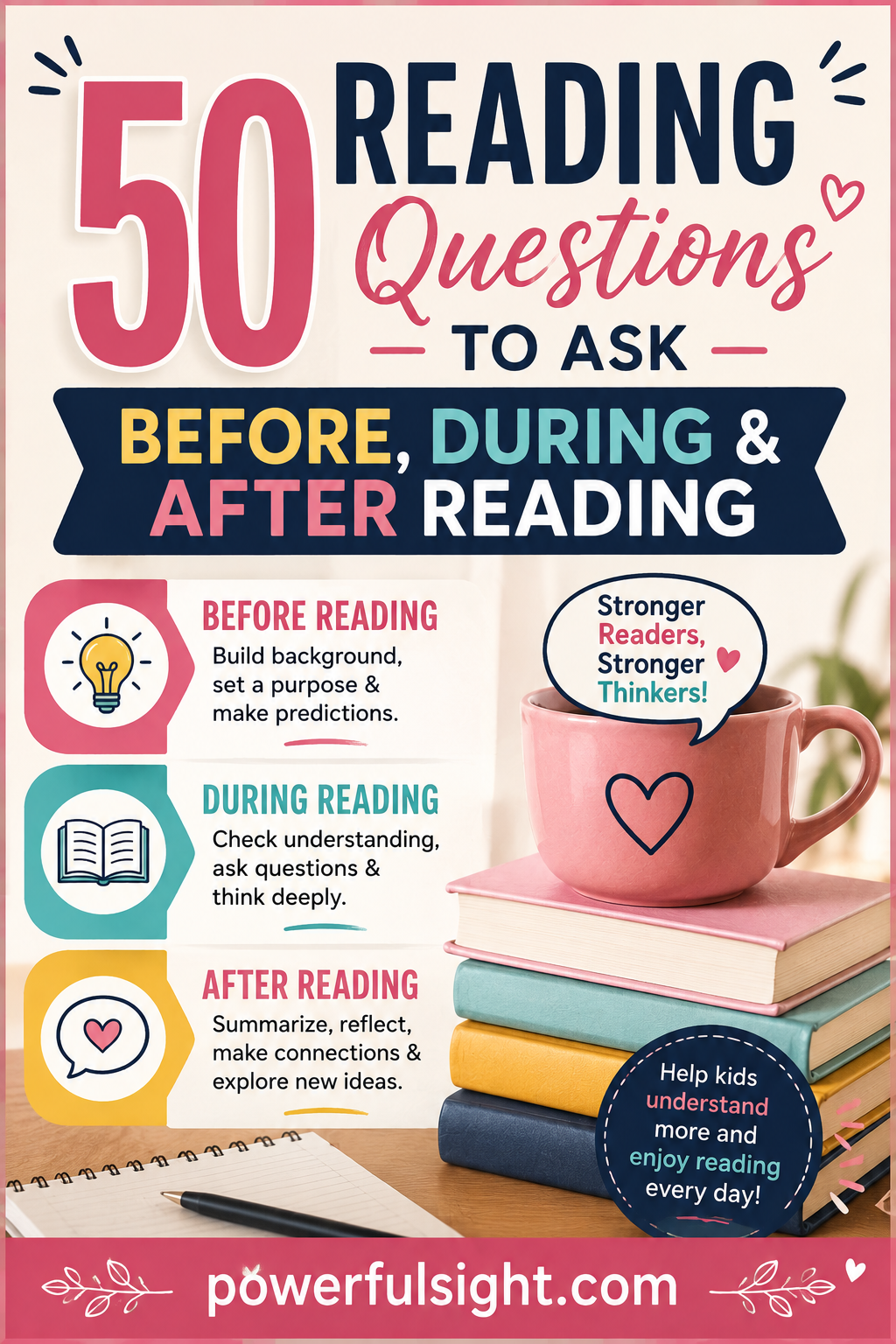
Save the pin for later

- 60 Color Tattoos That Healed Beautifully - 25/09/2026
- 40 Most Painful Tattoo Spots - 24/09/2026
- 20 Tattoo Aftercare Mistakes That Ruin Fresh Ink - 23/09/2026

