The most personal tattoo you can get isn’t a design at all. It’s handwriting: a real person’s actual letters, saved forever on your skin.
That’s the pull of a handwritten tattoo. A note from a parent, the signature of someone who passed away, your child’s first wobbly attempt at their own name, or a phrase scrawled on a birthday card. Anyone can pick a font from a wall, but tracing someone’s hand feels like carrying a piece of them.
Delicate works best here. Fine, personal script sits quietly on the wrist, collarbone, or ribs, and it reads as a secret rather than a statement. The catch is that small lettering needs some care to stay readable over the years.
Below you’ll find 21 handwritten tattoo ideas for a soft, personal look, plus tips on sizing and placement so the writing stays legible as it ages.
Why Handwritten Tattoos Feel So Personal
A font is a style choice. Someone’s actual handwriting is a record of them: the pressure they put on the pen, the letters they never quite closed, the way their “r” leans a little too far forward. When that gets tattooed on you, you’re wearing a signature no one else can copy, because the original writer isn’t around to write it again.
That’s the difference between picking a design off a wall and tracing a real hand. A script font can look elegant, but it belongs to thousands of other people. Your mother’s grocery list belongs to her.
The Emotional Weight Behind the Ink
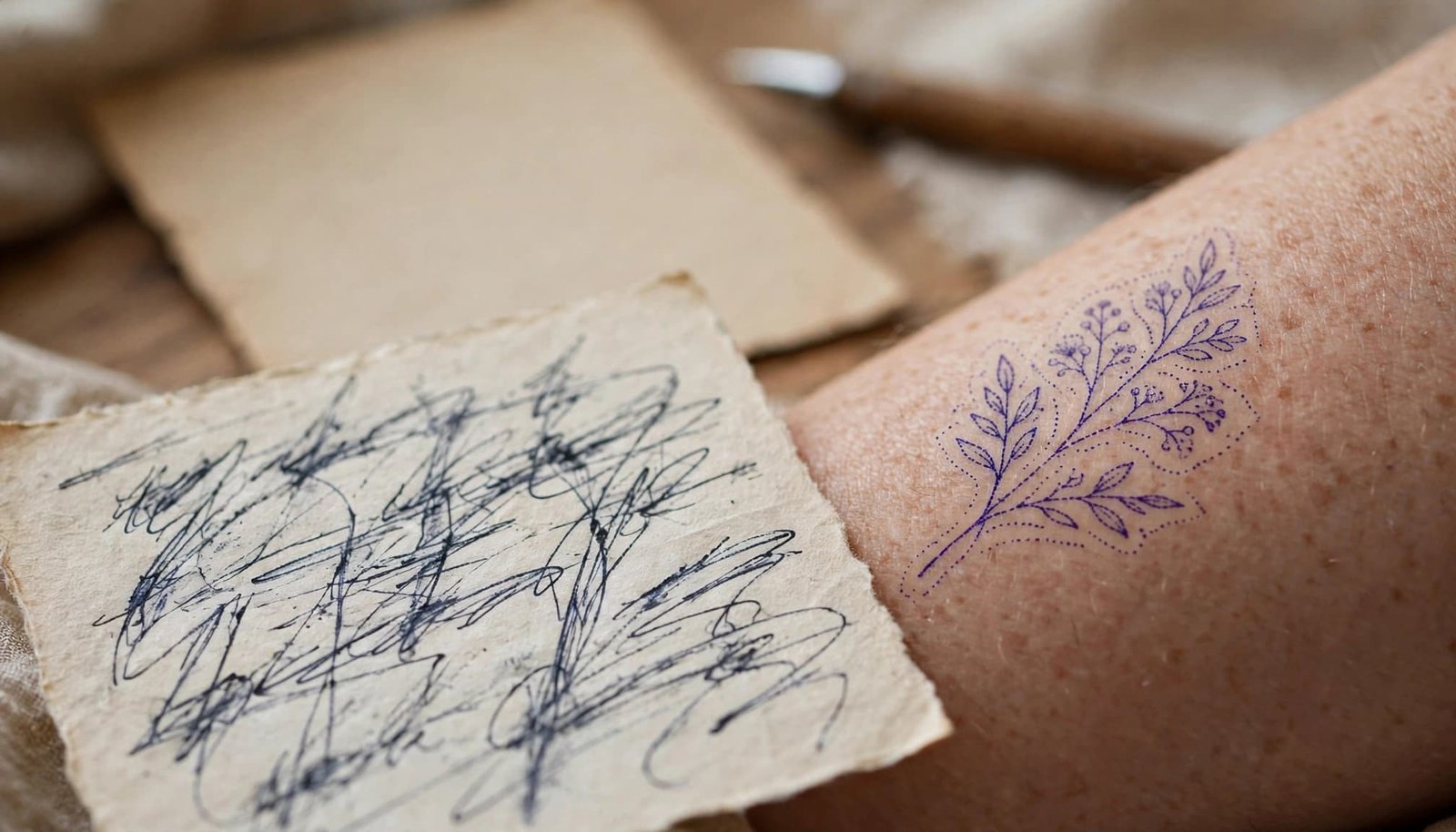
Most handwritten tattoos mark something you can’t get back. A memorial piece might use a parent’s signature from a birthday card you’ve kept for a decade. Others carry a love note, a child’s first attempt at writing their own name, or a grandmother’s handwritten recipe card. In each case, the tattoo is less about the words and more about the hand that wrote them.
Because that handwriting exists only in one place, usually on fragile paper, putting it on your skin protects it. Coffee stains and lost shoeboxes can’t touch it anymore.
The Imperfections Are the Point
Here’s what surprises people: the flaws are the best part. A shaky loop where arthritis crept in, a crossed-out word, ink that thins near the end of a line because the writer was getting tired. Those quirks are exactly what made the handwriting identifiable in the first place, and they’re what no font can reproduce.
When artists convert a note into a stencil, the goal is to clean it just enough to be tattooable while keeping the stroke variation, slant, and spacing intact. Over-polish it and you end up with generic lettering that could’ve come from any typeface catalog.
If a scan looks “too perfect,” you’ve cleaned away the very thing that made it theirs.
One practical note: delicate script needs room to survive healing, since fine lines blur as ink spreads under the skin. Asking your artist to size it slightly larger is preservation, not upselling, and their guidance on how fine line tattoos age explains why thin strokes soften over time.
Handwritten Tattoo Ideas for a Delicate, Personal Look
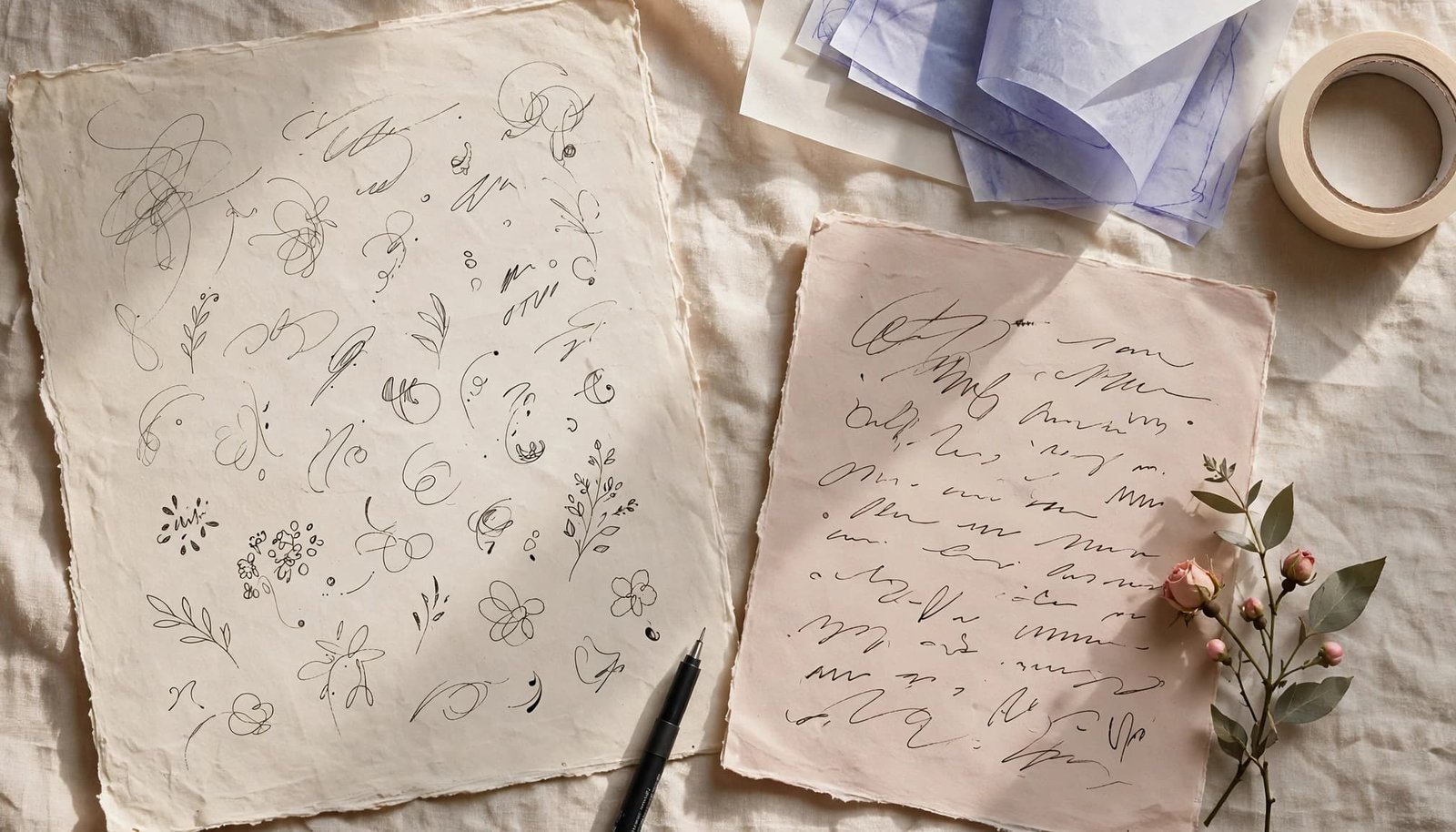
Each idea below starts with one thing: real writing from a real person. Dig through old cards, letters, journals, recipe boxes, and phone notes before you settle on a phrase. The words matter, but the hand behind them matters more. Once you’ve found your source, your artist can trace it directly into a stencil and size it to fit wherever you want it to live.
Meaningful Words and Messages to Ink
These first seven ideas lean on sentiment rather than size. They work because the source material already carries emotional weight, so the design barely needs decoration.
- A loved one’s handwritten note or letter. Pull a single line from a card or letter you’ve kept for years, like “always proud of you” from a birthday card. It fits beautifully along the forearm or ribs, and it reads like a private conversation only you can hear.
- A signature from someone special. A parent’s or grandparent’s signature, traced from a check, card, or legal document, makes a quietly powerful memorial piece. The inner arm or upper back suits the flowing loops of most adult penmanship.
- A child’s first written name. That wobbly, oversized attempt at their own name is a time capsule. Put it on the inner wrist or ankle while it’s fresh, because no font will ever replicate it.
- A favorite short quote in a parent’s hand. Ask your mom or dad to write out a line they actually said to you growing up. Their voice, in their letters, on your collarbone or shoulder blade, hits harder than any generic script.
- A word or mantra written by a partner. Have them jot “stay,” “breathe,” or “home” on paper, then ink it somewhere you’ll see it daily. The wrist works well since the point is frequent, quiet reassurance.
- A recipe note in a grandparent’s writing. A faded line from a stained recipe card, like the wording of her pie crust, turns Sunday dinners into permanent tradition. The forearm or thigh gives longer measurements room to breathe.
- Coordinates or a date jotted by hand. Ask the person connected to that place or moment to scribble the numbers themselves. Even five digits in their hand ties a birth, a hometown, or a first meeting straight to them.
The sourcing is the whole project here. Original cards and letters beat photocopies, since a high-resolution scan keeps pen pressure and slant intact for your artist to work from.
Delicate Script Designs for Small Placements
The next seven ideas are all about subtlety. Fine-line work, which uses single thin needles instead of grouped ones, makes tiny lettering possible, though it also means the design needs a little extra care to age well. Small script suits spots that stay mostly covered, and the FDA notes that all tattooing carries the same basic safety considerations regardless of size, so choose a licensed studio either way.
- A single word on the inner wrist. One word, four letters or fewer, sits cleanly on the flat strip of skin below your palm. It’s visible to you all day without announcing itself to anyone else.
- A short phrase behind the ear. Two or three words tucked behind the ear stay hidden until you pull your hair up. The curve of the area flatters vertical script especially well.
- Initials on the finger. Two or three letters along the side of a finger read like a permanent ring. Keep them under a quarter inch, and expect a touch-up eventually since fingers shed ink faster than most spots.
- A tiny line of script along the collarbone. A short phrase traced along the bone follows your body’s natural architecture. It peeks out from necklines and photographs beautifully.
- Handwriting wrapped around the ankle. A phrase circling the ankle works like a bracelet, with the words meeting at the back. Ankles handle fine lines well because the skin there is smooth and stable.
- A small note on the inner arm. The soft inner forearm is the classic home for personal script, and for good reason: it’s flat, low-friction, and easy to cover for work. A full sentence fits comfortably.
- A micro-script date on the ribcage. Ribs hurt more than most placements, but a small date written in someone’s hand lives there privately forever. Keep it in a straight line so the curvature doesn’t distort the numbers.
Whatever you pick, err on the larger side. Lettering that starts at a quarter inch tall stays readable for decades, while micro text can blur into a soft line as ink naturally spreads under the skin.
Creative Twists on Classic Handwriting Tattoos
The final seven add small artistic elements around the writing. Each one keeps the script as the centerpiece, with the decoration playing a supporting role.
- Script with a heartbeat or soundwave line. Run a flatline-turned-heartbeat beneath a phrase, or use an actual soundwave from a saved voicemail. Pairing “I love you” spoken aloud with its waveform is about as personal as ink gets.
- Handwriting with a tiny flower or sprig. A single lavender stem or baby’s breath sprig tucked under a line of script softens the whole design. This pairing suits the collarbone, forearm, or outer shoulder.
- A handwritten word inside a delicate circle or wreath. Framing one word, like “family,” in a thin hand-drawn ring gives small script structure and presence. It reads almost like a seal or wax stamp.
- Mirrored or stacked script for a vertical layout. Flip the writing so it reads correctly in a mirror, or stack words letter over letter down the spine. Both approaches turn ordinary penmanship into something sculptural.
- Handwriting mixed with roman numerals. Let the date of a birth or anniversary shift into roman numerals mid-line, or set numerals beneath a handwritten phrase. The contrast between soft script and carved-looking numerals adds quiet contrast.
- A handwritten lyric with one accent word in bolder ink. Trace the full lyric lightly, then have your artist go heavier on a single word like “always.” That one thickened word guides the eye and adds depth without clutter.
- White or UV ink for a hidden-ink effect. White ink heals as a faint pale ghost of the writing, and UV ink stays invisible until blacklight hits it. Both fade unpredictably and are harder to remove later, so treat them as an experiment rather than a keepsake.
However you decorate it, the handwriting should stay the loudest element. A sprig, a wave, or a thin ring is a frame, and the frame should never outshine the picture.
One last practical note before you book: tattoo inks aren’t pre-approved by the FDA, which advises consumers to ask studios which inks they use and to avoid products named in any safety alerts about contaminated tattoo inks. A reputable artist will answer happily, and that conversation is worth having before anything permanent touches your skin.
Where to Place a Handwritten Tattoo So It Stays Readable
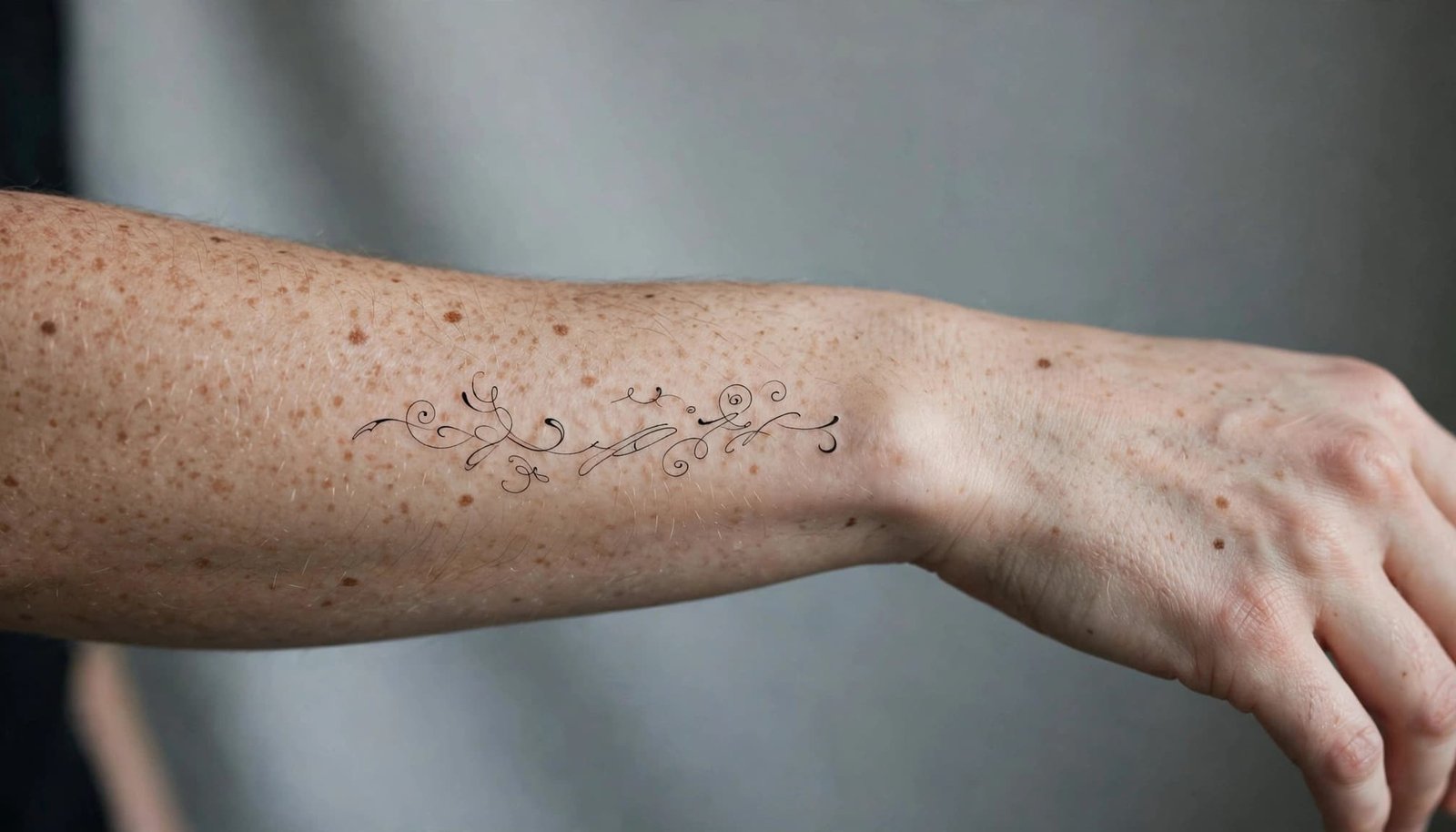
Placement decides two things at once: how the writing looks on your body and how long it stays legible. The same phrase that heals crisply on the forearm can fade to a soft smudge on a finger within a couple of years. Skin that gets rubbed, stretched, or washed constantly sheds ink faster than calm, protected areas.
Spots That Keep Script Crisp for Years
If longevity is the goal, choose skin that barely moves and rarely rubs against clothing. These areas hold ink well because the surface stays smooth and stable:
- Outer forearm, the classic home for personal writing
- Upper arm and shoulder, low friction and easy to shade from the sun
- Thigh, plenty of flat space for longer phrases
These placements also give delicate letters room to breathe. The more spacing between words, the better the tattoo survives the natural spread of ink under the skin.
Spots That Fade Faster
Some locations look gorgeous on day one and struggle by year two. Hands, fingers, feet, and the neck all combine thin skin, constant motion, and frequent washing, so expect a touch-up fairly early if you go there. Sun exposure makes it worse; UV light is the biggest single cause of fading, which is why artists push daily SPF on anything visible.
Finger tattoos in particular almost always need a refresh, and many artists suggest planning on one within the first two years. If you love the idea anyway, ask for slightly thicker strokes and simpler lettering to buy the design time.
Sizing Script So It Ages Well
However you place it, tiny lettering is the enemy. Micro-text with hairline strokes blurs first as ink spreads during healing, and tightly packed cursive is the most vulnerable of all. Script with open spacing and slightly thicker strokes stays readable far longer, and a guide to small tattoos with personal meaning makes the same point about keeping fine details legible as they heal. Ask your artist to print the stencil at actual size, then read it from arm’s length. If you squint, size it up before anything touches skin.
How to Get the Handwriting Onto Your Skin
Once you’ve picked the writing, the practical work begins: capturing it cleanly, finding the right artist, and knowing what the appointment itself involves. Here’s the process from paper to healed ink.
Choosing and Preparing Your Source Writing
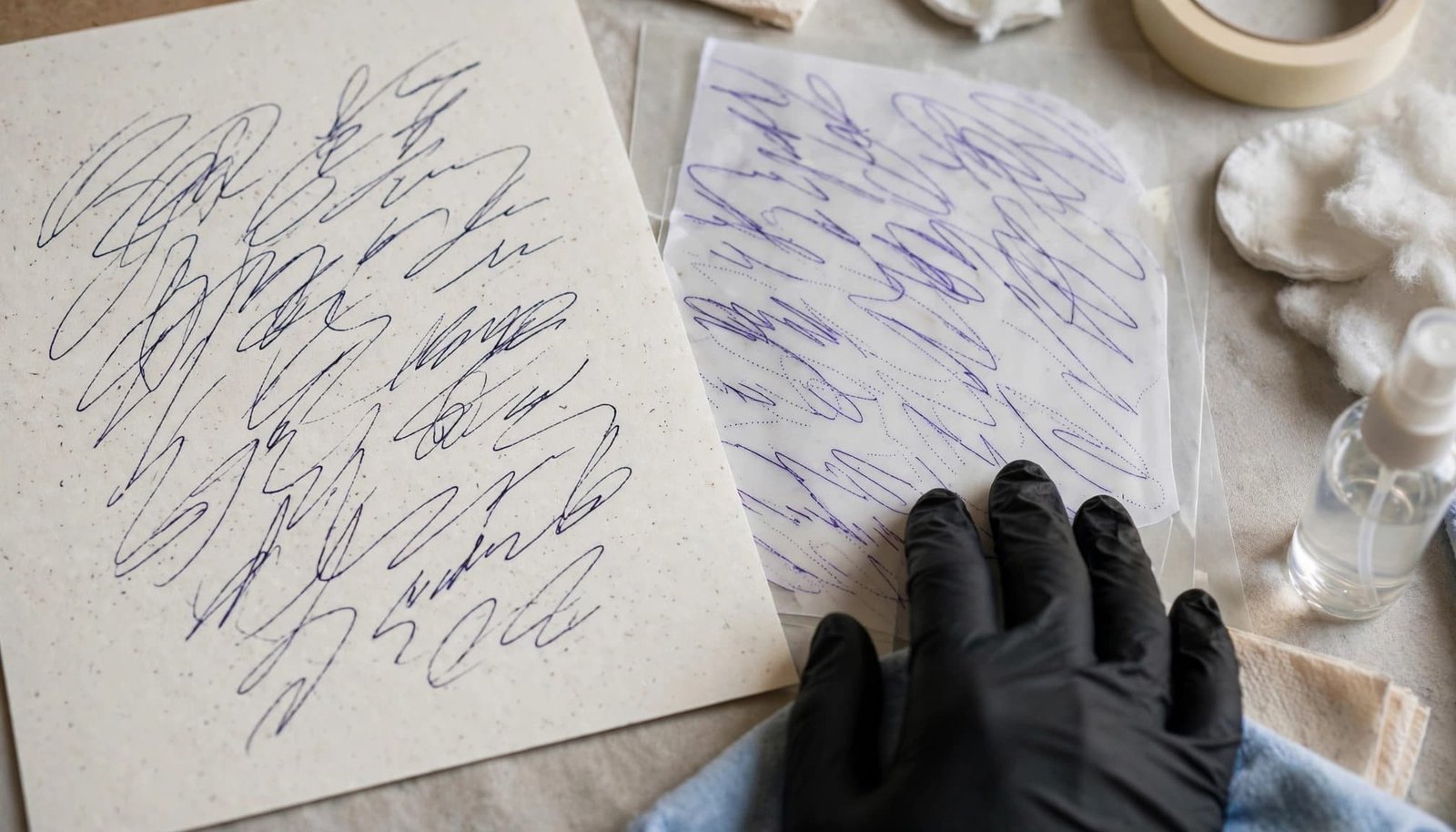
Start with the best original you can find. Dark ink on light paper gives your artist the most to work with, so a ballpoint note beats a faded pencil sketch every time. Letters should be large enough that individual strokes are visible; if you have to squint at the paper, a scanner will struggle too.
Photograph or scan the writing flat, in even light, with no shadows across the page. Apps like Pen to Print or InkScan can digitize and transcribe the text, which helps you confirm exactly what it says before you commit. Just remember your artist needs the image, not the transcription, since the visual shape of each letter is the whole point. A good artist will clean up a scan by smoothing broken strokes and removing stray marks while keeping the slant, spacing, and pressure variation intact.
Working With a Fine-Line Tattoo Artist
Look for someone who specializes in fine-line or script work specifically. An artist’s feed is full of fresh tattoos, and fresh fine-line always looks sharp. Ask to see healed photos, ideally taken three or more months after the work was done, and check whether the line weight stays consistent and the letter ends haven’t faded or blurred.
Once you’ve chosen an artist, be explicit about what to preserve. Point out the crossed-out word, the shaky loop, or the exact spacing you want kept. Fine-line work also depends on precise needle depth, because a needle set too shallow will fall out during healing and one set too deep will spread. That’s experience you can’t shortcut, and it matters more than price when you’re comparing studios.
Cost, Pain, and Session Expectations
Small script pieces are among the most affordable tattoos you can get. Most shops charge between $50 and $200 for a short line of handwriting, since the price usually reflects the shop minimum rather than an hourly rate. Sessions run short too; a small script piece often takes 30 to 60 minutes including stencil placement.
Pain depends entirely on placement. Fleshy areas like the outer forearm or thigh feel mild, closer to a light scratch, while ribs, fingers, and the collarbone sting noticeably more. Because the session is brief, most people handle the sharper spots fine. The FDA’s consumer guide to tattoo safety covers infection risks and aftercare, so read it before your appointment. And if this is a memorial piece, pairing the script with a small symbol can work nicely; there are meaningful heart tattoo ideas that combine text with simple fine-line shapes.
Caring for a Fine-Line Script Tattoo So It Stays Crisp
A fine-line script tattoo is only half finished when you leave the chair. The healing phase and the years after decide whether those thin letters stay legible or soften into a faint smudge. Because the strokes are so delicate, they respond to care faster than bolder work does, in both directions.
Aftercare During the Healing Phase
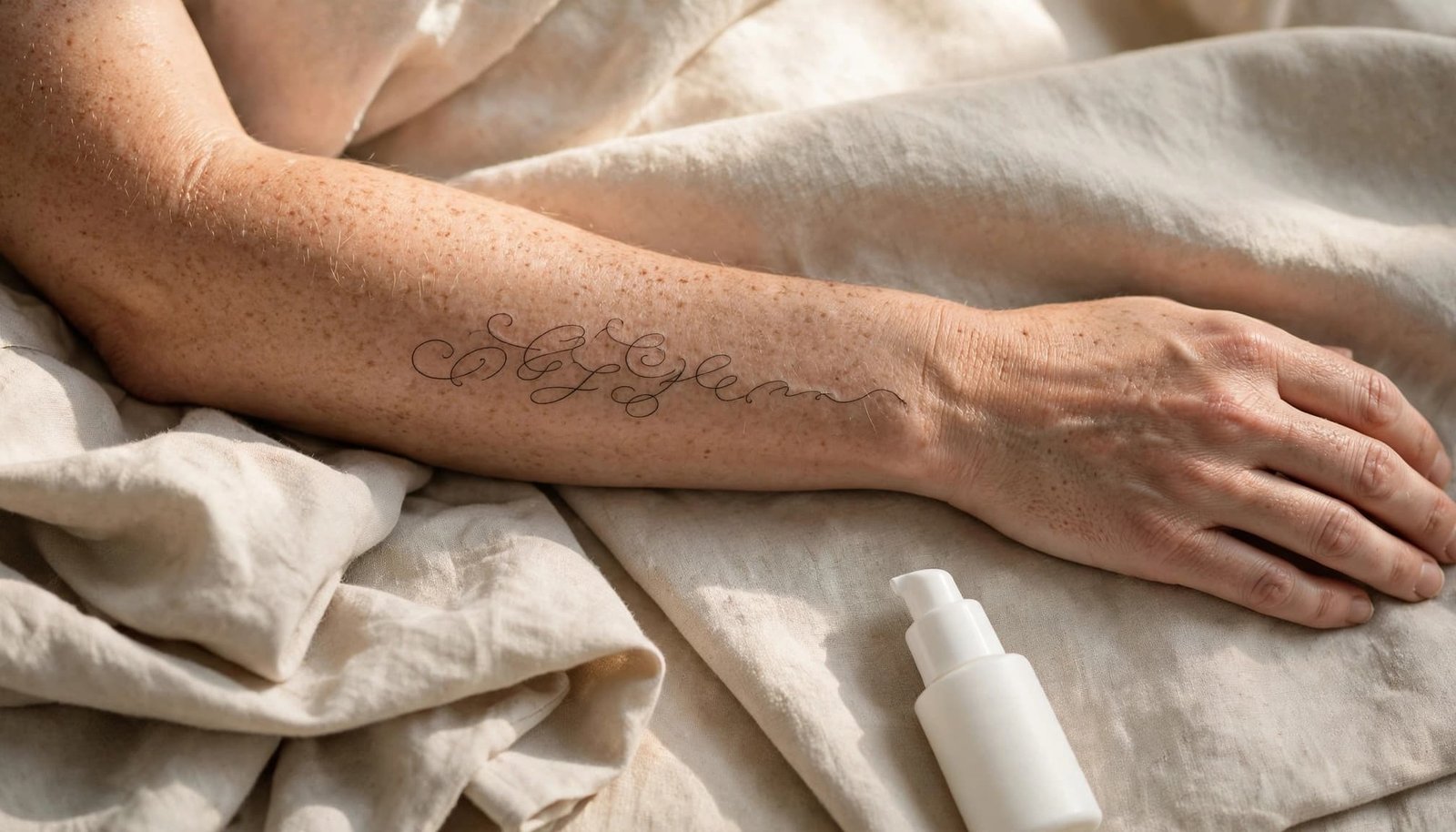
For the first two to three weeks, treat the tattoo like a healing wound, because that’s exactly what it is. Wash it gently with lukewarm water and a fragrance-free soap twice a day, using clean fingertips instead of a washcloth. Pat it dry with a clean paper towel; never rub.
After washing, apply only a thin layer of fragrance-free lotion. A thick coat traps moisture and can pull ink out of fine strokes, so less is genuinely more here. Resist picking or scratching as the skin flakes and itches; every scab you tear off takes a little ink with it.
Two habits matter most for delicate lettering:
- Skip baths, pools, hot tubs, and lakes entirely for two to three weeks. Showers are fine, but no soaking.
- Cover the tattoo with loose clothing rather than sunscreen while it heals, since SPF belongs on skin only after it has closed.
The same friction rules apply to any fine-line piece, and advice on caring for dotwork tattoos after healing reinforces how much gentle handling protects thin detail.
Long-Term Habits That Protect Thin Lines
Once healed, the sun becomes your script’s biggest enemy. UV light breaks down ink pigment, and hairline strokes fade first because they hold the least ink to begin with. Apply broad-spectrum SPF 30 or higher (SPF 50+ is better) every day the tattoo sees daylight, and reapply every two hours outdoors. Pair that with daily moisturizing, since hydrated skin holds lines sharper than dry, flaky skin.
Sunscreen is the cheapest touch-up you’ll ever give a tattoo.
Even with good habits, thin script naturally softens over time. Plan on a touch-up every five to seven years for stable placements, and sooner for fingers or feet. Wait until the tattoo is fully healed, at least six to eight weeks, before booking one, so the artist works on settled skin. The sun protection habits covered in this guide to sunscreen and healed tattoo care apply year-round, even in winter.
Handle it well, and those letters can stay readable for decades.
Mistakes to Avoid With a Handwritten Tattoo
Handwritten tattoos are forgiving in sentiment but unforgiving in execution. A small slip in planning shows up on your skin for decades, so it pays to know the common missteps before you book. Check every detail against the original writing, because once the ink sets, there’s no undo button.
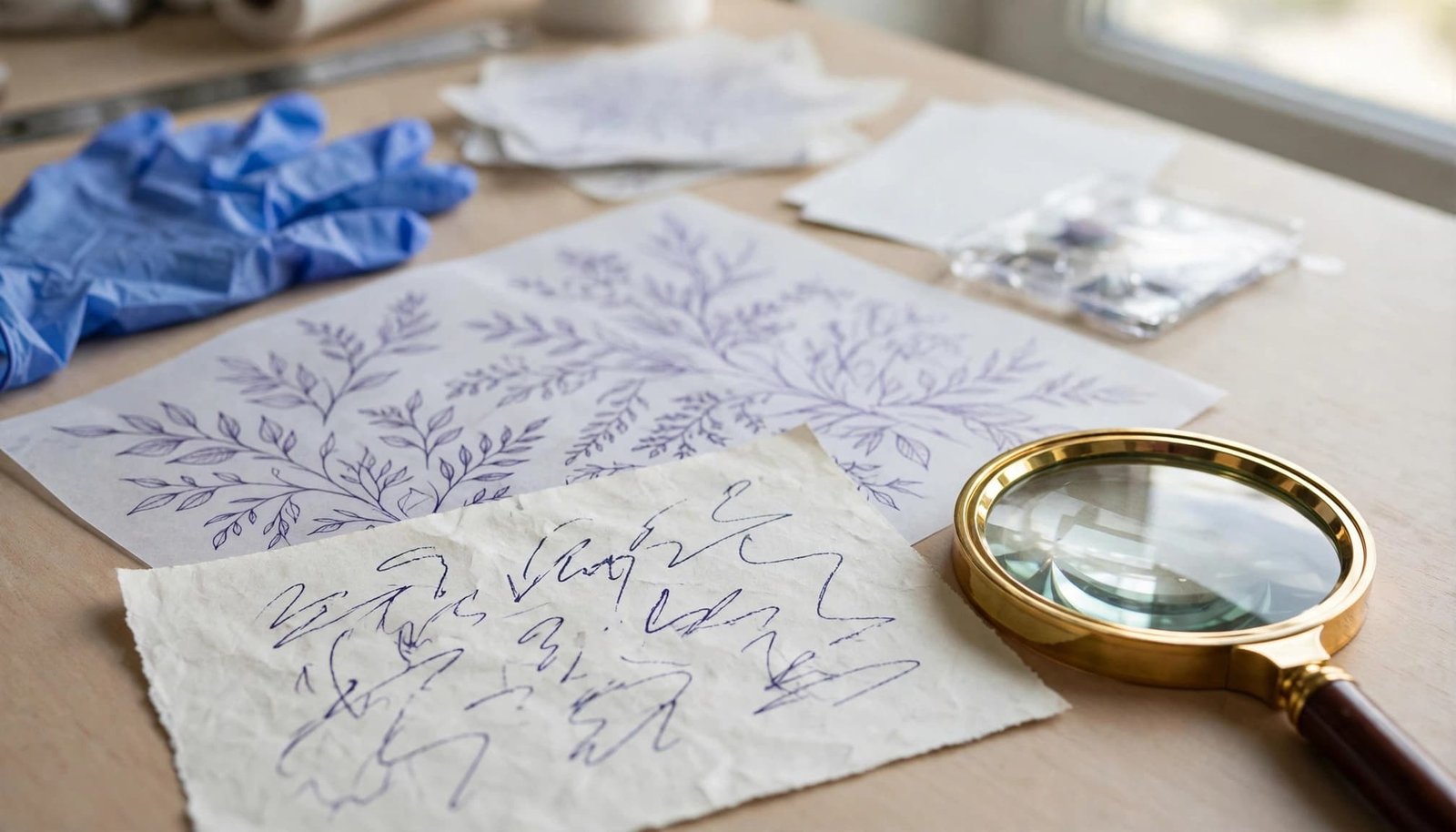
- Do size the lettering generously; don’t shrink script until the strokes are hairline thin, since tiny letters blur first as ink spreads under the skin.
- Do proof the source text twice, checking spelling, dates, and punctuation against the original; don’t tattoo from memory, because a missed accent or swapped digit is permanent.
- Do choose calm, low-friction skin like the forearm or shoulder; don’t put delicate script on fingers, hands, or feet, where constant rubbing fades it fast.
- Do pick an artist with healed fine-line examples in their portfolio; don’t trust fresh photos alone, since new work always looks sharp.
- Do apply broad-spectrum SPF 30 or higher once healed, as the American Academy of Dermatology notes that UV light fades tattoo ink; don’t skip it, because thin strokes hold the least ink and fade first.
Catch these five early, and the rest of the process is easy.
Conclusion
A handwritten tattoo is one of the most personal choices you can make, because the writing belongs to one person and no font can copy it. The best results come from four things working together: meaningful source writing, a fine-line artist with healed examples in their portfolio, a calm placement like the forearm or shoulder, and consistent aftercare with daily SPF once the skin heals.
Start with the idea that tells your story. If you want to keep exploring delicate script, these delicate sister tattoo ideas show how shared handwriting can work between two people, while these baby name tattoo ideas pair names and dates with fine-line detail.
Proof the original twice, size the lettering generously, and the words you carry will stay as readable as the day you got them.
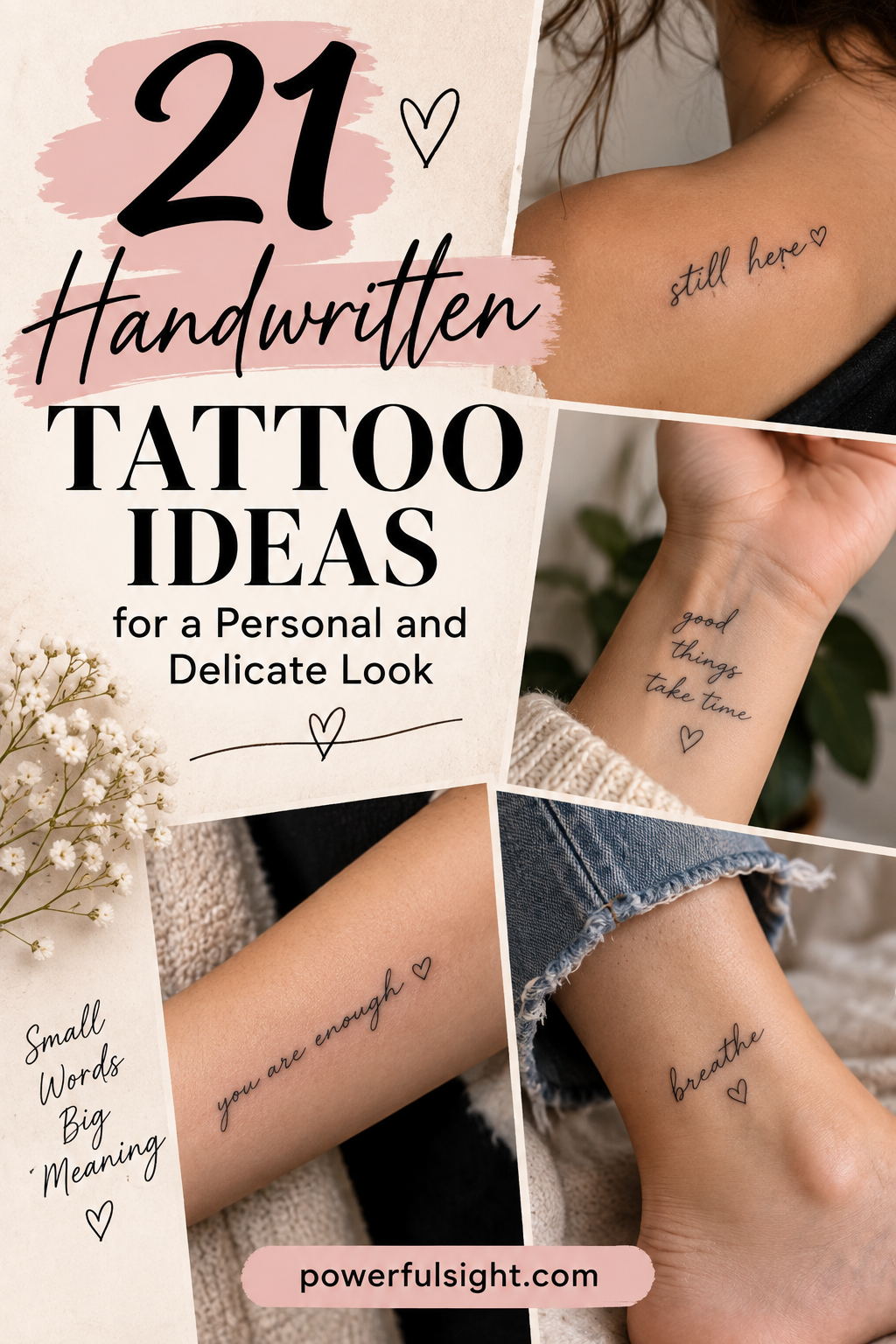
Save the pin for later

- 60 Color Tattoos That Healed Beautifully - 25/09/2026
- 40 Most Painful Tattoo Spots - 24/09/2026
- 20 Tattoo Aftercare Mistakes That Ruin Fresh Ink - 23/09/2026

